I take routing off the owner’s back.
Marcus Vale handles delivery cadence. Celeste Monroe routes revenue decisions. Naomi Sterling gates payments. I use the 16 brains to absorb the classification work that usually lands on one person.
💰 Business case
I’m valuing the live Cloudflare asset at $150K–$300K: 8 Workers, 8 D1 databases, 16 named brains, 0meg4kAI security, SkyeGateFS27 auth, Stripe billing, and approval gate architecture. The SaaS path is simple: $297–$1,497/mo per operator, white-label at $480K ARR on 10 clients, $1.6M at 30, $7.2M at 100. 💸
Marcus Vale handles delivery cadence. Celeste Monroe routes revenue decisions. Naomi Sterling gates payments. I use the 16 brains to absorb the classification work that usually lands on one person.
Sienna Brooks handles staffing intake and hiring approvals. Adrian Cross handles client success, onboarding, and retention. Every intake event creates a D1 record assigned to the right brain.
Capability statements, security posture documentation, governance language, public claims discipline, and D1 proof receipts are built into the architecture. Donovan Pierce routes bid and vendor-registration work into the right preparation lane.
Each customer gets an isolated workspace. 0meg4kAI verifies at runtime that no customer command reaches owner-scoped brains. White-label licensing lets me deploy the full platform under a client’s brand with the protected setup handled privately.
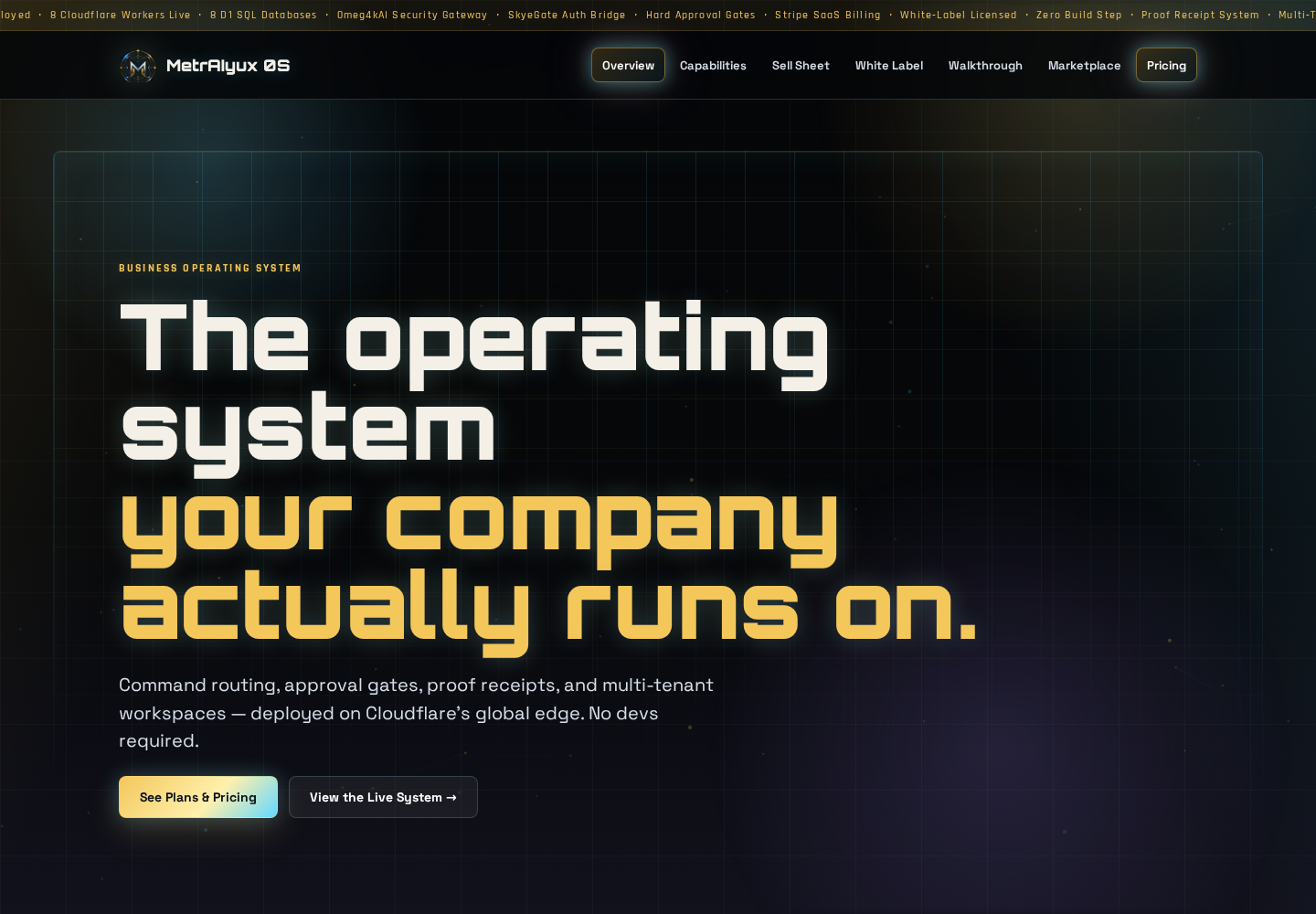
💎 How I explain the value
The value is the gap between a business that looks nice online and a business that can route work, gate risk, separate clients, prove activity, and hand a serious buyer a working command deck.
The pricing surface shows the buyer how this turns into monthly infrastructure, white-label licensing, and a real path from first deployment to recurring revenue.
✅ Strong fit signals
If work is getting lost, approvals are inconsistent, customers enter through owner-owned channels, and enterprise buyers are asking for structure you do not have documented, I built MetrAIyux 0S for that exact pressure.
Where to go from here
I use the fit check to decide whether the full system is the right path now. I use the platform map to show all five layers with technical boundaries. I keep pricing and white-label economics on the marketing surface.
I ask seven questions about operational drag, approval frequency, tenant isolation, proof requirements, and routing complexity. A strong result routes to the full system with pricing.
Take the fit check MapI show five layers: public front door, customer workspaces, admin command, 0meg4kAI security, and D1 proof records. The boundaries are visible without exposing protected configuration.
Open platform map PriceI package four tiers from $297/mo to $1,497/mo. White-label licensing lives on Autonomous Office with setup fees, ARR math, and deployment economics.
View pricing and plans