✅ Fit scoring — seven questions

I’ll be straight with you: this belongs where complexity is already expensive.

I ask seven questions about work volume, routing complexity, tenant isolation, approval discipline, proof requirements, multi-brain needs, and buyer education pressure. A high score opens the full command deck. A medium score points to a phased start. A low score means I would rather see you document the operation before putting a 16-brain system on top. ✅

How many active work streams — clients, candidates, vendors, approvals, delivery items — need tracking each week?

How scattered is your current operating stack?

Do you need customer or client workspaces that are structurally separate from your admin command layer?

How often do you need documented approval on contracts, payments, hiring decisions, or public claims?

Would D1 proof receipts — queryable records of every routing decision, scan result, and approval outcome — make your company easier to sell, defend, or pass diligence?

Does your operation have enough functional complexity to warrant 16 distinct routing lanes — operations, sales, finance, legal, HR, tech, marketing, government, partnerships, QA, and expansion?

Would a public site that explains your operating model — including named functions, approval gates, and tenant isolation architecture — help serious buyers qualify themselves before talking to you?

Open Full Website
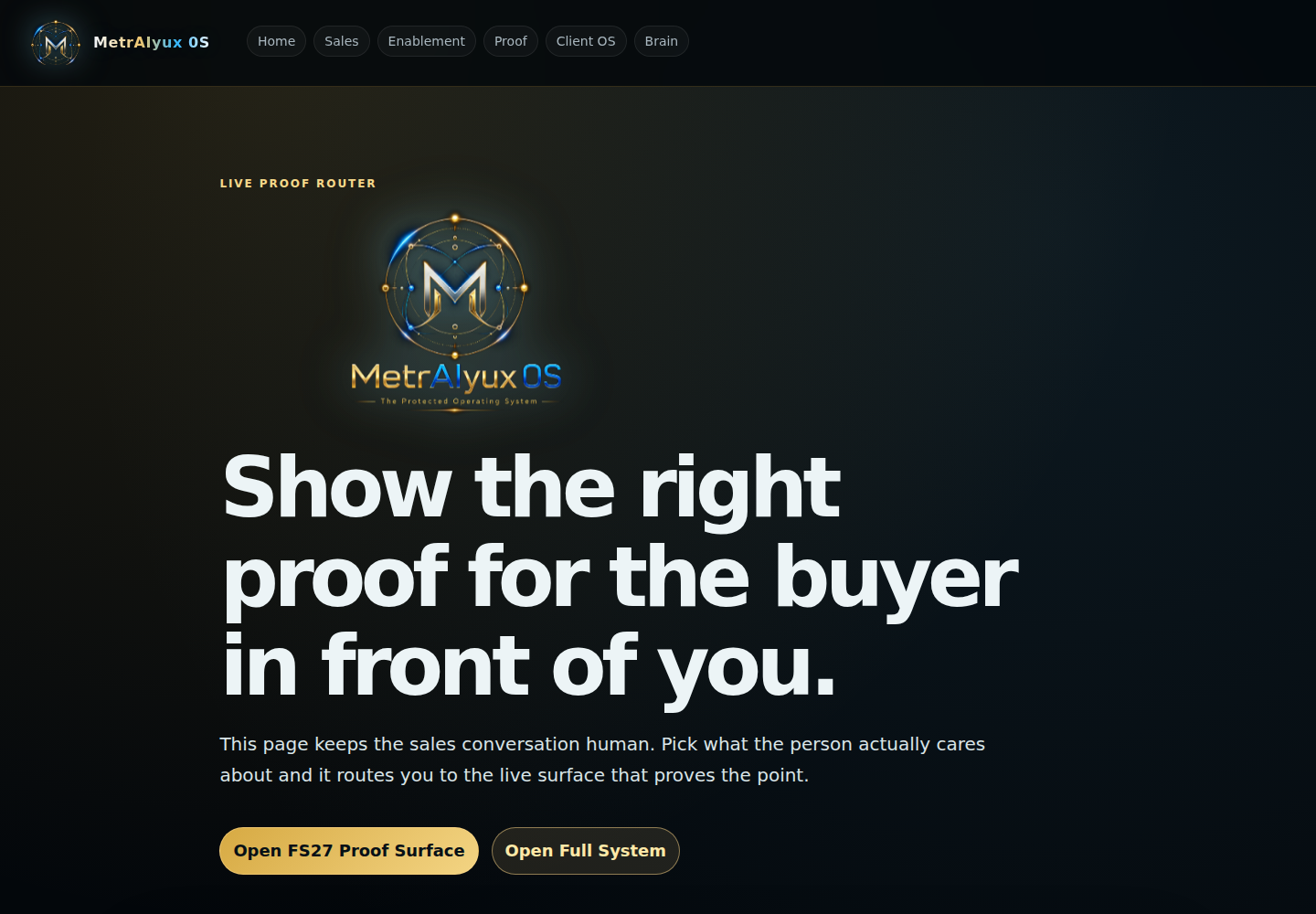
Live proof router screenshot

🧭 After the score

I route the answer instead of forcing a close.

If you are high fit, I send you to the full system and pricing. If you are medium fit, I send you into the tour and platform map. If the score is low, I point you toward documentation first. I want the next click to be honest.

Proof router

The fit check has somewhere real to send you.

This is why I built the live proof router: different buyers need different evidence, and the route should match the pressure.